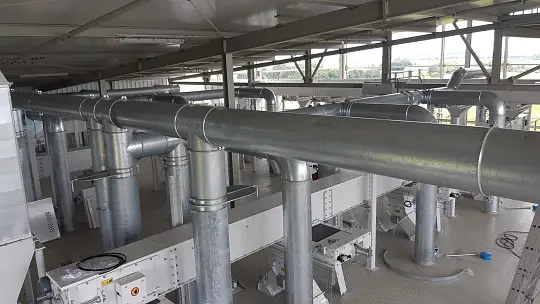
Conveyors connect every part of a grain plant: intake, cleaning, the dryer, the silos and loading. Most plants use several types, each on the route it is made for. The choice is made per route, not per plant.
The chain conveyor
Grain is pushed by paddles fixed on a chain, inside a closed casing. It is robust, dust-free and can have several discharge points along its length.
- Best for: silo tops, distribution galleries, enclosed horizontal runs.
The belt conveyor
Grain rides on a moving belt. Handling is gentle, and distances can be long, at high throughputs.
- Best for: long distances, loading ships and wagons, products sensitive to breakage.
The screw conveyor
A rotating screw, in a trough or tube, pushes the grain. It is compact and simple.
- Best for: short transfers and silo discharge.
- Good to know: over long distances and at high throughputs it uses more energy and is harder on the grain.
Choose per route: length, throughput, product and where it is installed.
What else matters
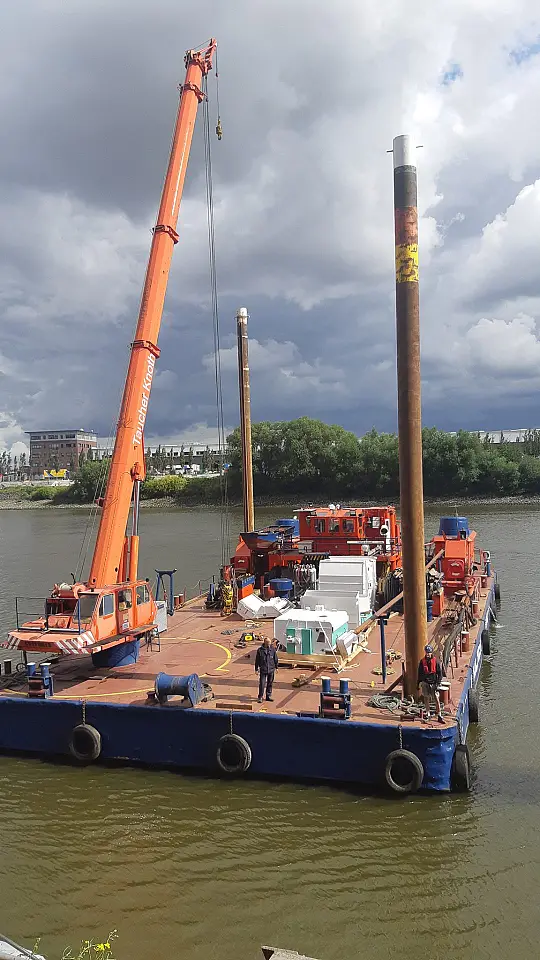
A conveyor comes with everything that carries it and makes it accessible: conveyor bridges, walkways, railings, gravity spouts and distributors. Much of it is installed at height, on silo roofs, where planning the installation matters as much as choosing the equipment.
Send us a sketch of the routes, with lengths and throughput, and we will propose the right mix of conveyors for your silos and the rest of the plant.