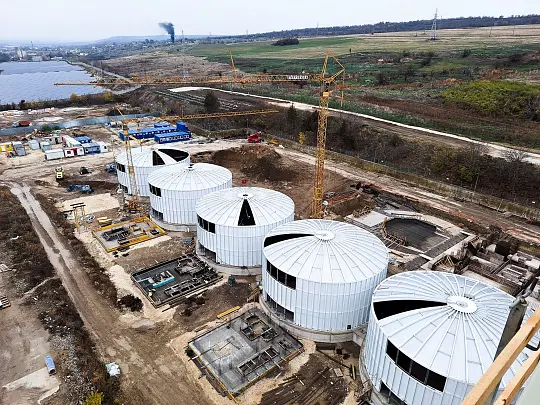
A malthouse turns barley into malt in three stages: steeping, germination and kilning. The kernels are brought to germinate under controlled conditions, then stopped at the right moment with warm air. Around the process sits everything that moves the grain: intake, cleaning, silos, elevators and conveyors. This guide walks through each stage, the equipment it needs and the decisions you take when you plan a new malthouse or extend an existing one.
From barley to malt: the process at a glance
Malting is controlled germination. In the barley kernel, germination starts enzymes that break down the cell walls and part of the protein, and that later convert starch into fermentable sugars in the brewhouse. The maltster lets that work go as far as the malt type needs, then stops it by drying. A typical batch goes through:
- Intake, cleaning and storage of barley, until the grain is past its dormancy and ready to germinate.
- Steeping, about one and a half to two days, until the kernels take up enough water to start germinating.
- Germination, usually four to five days, on perforated floors with conditioned air and regular turning.
- Kilning, roughly a day, in which the green malt is dried and cured.
- Deculming, storage and dispatch of malt: the rootlets are removed and the malt rests in silos before delivery.
Each stage has its own equipment, and between them the grain must be moved gently, without breaking kernels and without mixing batches. A malthouse is as good as the weakest link in this chain.
1. Barley intake, cleaning and storage
Malting barley is bought on specification: high germinative capacity, a protein content within the range the brewers ask for, plump and even kernels. At intake each lot is sampled, then cleaned and graded. Pre-cleaners remove straw, dust and stones; graders separate the thin kernels, which malt unevenly and are sold as feed.
Freshly harvested barley is often dormant and will not germinate evenly for several weeks. It is therefore stored in silos with aeration and temperature monitoring, kept cool and dry until it is ready. That makes barley storage a planning question in its own right: the malthouse needs enough silo capacity to bridge the time between harvest and processing, separated by variety and quality.
2. Steeping
In steeping, the cleaned barley is brought from storage moisture to the moisture at which germination begins, typically in the low to mid forties as a percentage. The grain does not simply sit under water: wet stands alternate with air rests, in which carbon dioxide is drawn off and fresh air is supplied, because the kernel is already breathing. Water temperature, the length of each stand and the aeration decide how evenly the batch starts to germinate.
Equipment for steeping
- Steeping vessels, usually cylindrical with a conical or flat bottom, with aeration and CO2 extraction;
- water supply and drainage sized for filling and emptying a full batch in a short time, plus the treatment of the steep water;
- a gentle transfer of the wet grain to germination, by gravity, by water or with conveyors suited for wet material.
Steeping uses most of the process water in a malthouse. Water supply, drainage and effluent are therefore among the first questions when a new site is assessed.
3. Germination
The steeped grain is spread on perforated floors in germination boxes or circular vessels. Humidified, temperature-controlled air flows up through the bed and carries away the heat produced by the germinating grain. Turners move slowly through the bed at regular intervals so that the rootlets do not mat together and the temperature stays even from top to bottom.
Common germination designs
- Rectangular boxes (Saladin type), with a turner travelling along the box. Simple to build in stages, which is why they are frequent in extensions.
- Circular germination vessels, with a rotating floor or a rotating turner arm. Compact, well suited for large batches and for automation.
- Combined vessels, in which steeping, germination and sometimes kilning take place in the same vessel. Typical for smaller and craft malthouses.
Whatever the design, germination is about air: fans, ducts, humidifiers and cooling must hold the bed in a narrow temperature band for days, in every season. Floor, turner and air system are designed together, for the batch size you want to produce.
4. Kilning
In the kiln, germination is stopped by drying the green malt with warm air, in stages. In the first phase, the free drying, large volumes of moderately warm air carry away most of the water while the enzymes are protected. Once the bed reaches the break point, the air temperature is raised and the malt is cured. This is where the colour and aroma form: a pale malt is cured at lower temperatures than a darker, more aromatic one.
Equipment for kilning
- the kiln floor and the air chambers above and below it;
- fans, heaters or heat exchangers and air ducts, sized for the load of each batch and for the curing temperatures;
- heat recovery from the exhaust air, because kilning is the most energy-intensive part of malting;
- controls that follow the air temperature, the humidity and the time of each stage.
Energy cost per tonne of malt depends to a large extent on how well the kiln and its heat recovery are designed. It is worth comparing configurations at the design stage, not after commissioning.
5. Deculming, malt storage and dispatch
After kilning, the dry rootlets are removed in a deculmer and sold as feed. The malt is then conveyed to silos, where it rests for a few weeks before use and is kept separate by type and batch. From there it is cleaned again, weighed and loaded in bulk or in bags. The handling equipment here must be gentle: broken malt kernels cost money in the brewhouse.
A malthouse is not only the process. It is also everything that moves barley and malt between the stages.
Grain handling: the part that decides daily operation
In a malthouse the same grain is moved many times: from intake to cleaning, to barley silos, to steeping, to germination, to the kiln, to deculming, to malt silos and to dispatch. Each transfer is a chance to break kernels, to mix batches or to lose time. That is why the handling equipment is designed together with the process, not added afterwards:
- bucket elevators with low belt speeds and suitable buckets for gentle lifting;
- chain and belt conveyors that empty completely, so batches do not mix;
- silos for barley and malt, separated by variety, quality and malt type;
- dust extraction and explosion protection where grain dust is generated.
Industrial or craft malthouse?
An industrial malthouse runs large batches continuously, with separate steeping, germination and kilning lines and a high level of automation. A craft malthouse produces small batches, often several malt types in a week, and usually works with combined vessels or a compact line. The process stages are the same; what differs is the batch size, the degree of automation and how much flexibility the plant needs.
For a craft project the questions are mostly about the building, the utilities and the handling of many small lots. For an industrial plant they are about throughput, energy and how the line can be extended later without stopping production. In both cases, the batch size is the number from which everything else is sized.
What to clarify before planning a malthouse
- Capacity: tonnes of malt per year and the batch size you want to run.
- Malt types: pale base malts only, or also special and darker malts, which need different kilning.
- Site: a new building or an existing malthouse to extend; the space for silos and dispatch.
- Utilities: water supply and effluent, electrical power, the energy source for the kiln.
- Barley logistics: how the grain arrives, how much must be stored before processing, how the malt leaves.
- Schedule: when production should start, and for an extension, which periods allow a switch-over.
Extending an existing plant has its own rules: the new section is built next to the running one and connected in stages. We describe how in extending a malthouse without stopping production.
How Raukler builds malting plants
We design and install malting lines turnkey: the process layout, steeping, germination and kilning equipment, ventilation and piping, together with the elevators, conveyors and silos for barley and malt. Our own crews install the plant, and the training of your operators is part of commissioning. Where the process needs a building, we design the steel hall around it.
Send us the capacity, the malt types and the site. We reply within 24 hours and arrange a first technical discussion, free of charge.